
EQ-i 2.0 is the world’s leading measure of emotional intelligence
Most leaders believe they are self-aware. Far fewer actually are. That gap shapes how you make decisions, how you handle pressure, and how your team experiences you. I’m Gino DeMaio, Ph.D., an executive coach certified in the EQ-i 2.0 and EQ 360. I use these assessments to give you an honest baseline, and then we turn that insight into lasting change.
The good news is that emotional intelligence can be learned. You can develop it and improve it.
What emotional intelligence is
Emotional intelligence (EI) is your capacity to perceive, understand, use, and manage emotions—both your own and others’. Those emotions guide how you think and act.
For leaders, I use a practical definition. EI is the set of emotional and social capacities that shape how you see yourself and others, express yourself, build relationships, make decisions, and cope with pressure. These capacities can be measured and developed. They do not replace cognitive ability or technical skill. They work alongside both.
Three ways to understand emotional intelligence
Researchers define EI in three main ways. It helps to know which one you are working with, because the scores they produce are not interchangeable.
As an ability. This view treats EI as a form of intelligence that can be tested against right answers. You perceive emotions, use them to think, understand them, and manage them. Of the three approaches, it is the most rigorous in how it is measured.
As a set of traits. This view describes EI as how you see your own emotional and social tendencies. It is the foundation of the EQ-i 2.0.
As workplace competencies. This view groups EI into self-awareness, self-management, social awareness, and relationship management. It has the most influence in leadership practice. It is also the most criticized because its scope is broad, and its early claims about predicting performance went beyond the evidence.
What the EQ-i 2.0 assessment measures
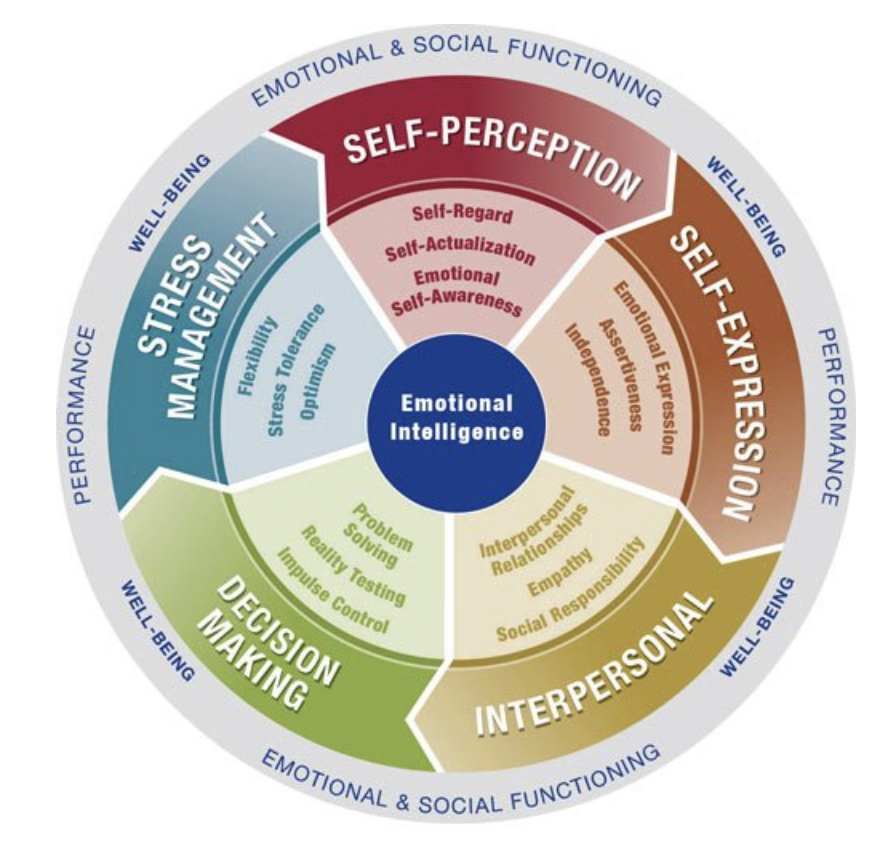
The EQ-i 2.0 is the world’s leading measure of emotional intelligence. It looks at 15 competencies in five areas:
Self-Perception: self-regard, self-actualization, emotional self-awareness
Self-Expression: emotional expression, assertiveness, independence
Interpersonal: interpersonal relationships, empathy, social responsibility
Decision Making: problem solving, reality testing, impulse control
Stress Management: flexibility, stress tolerance, optimism
These competencies are strongly linked to inspiring leadership, innovative cultures, effective teams, and engaged people.
The EQ-i 2.0 shows how you see yourself. The EQ 360 adds how others see you. The gap between the two is often where the most useful coaching happens.
What the research says
The evidence is encouraging, and it also has limits.
EI predicts performance. Large research reviews show that EI predicts job performance beyond cognitive ability and personality. The effects are modest. They are strongest in roles that carry heavy emotional demands.
Some claims go too far. Critics point out that trait measures overlap with personality. Popular slogans like “EQ matters twice as much as IQ” are not supported by the data.
EI can be developed. Training studies show moderate gains. That’s why EI belongs in coaching and leadership development.
Why an EQ-i 2.0 assessment and coaching work better together
An assessment gives you data. Coaching turns that data into changed behavior. Each one makes up for what the other lacks.
What the assessment gives you
A clear starting point. General impressions such as “I think I handle stress well” are replaced by a structured profile, which makes later growth measurable.
A view you can’t get on your own. People judge their own behavior poorly. Research suggests that most people think they are self-aware but only a minority actually are. A 360 shows you where your view and others’ views differ.
A shared language. Precise terms such as impulse control, assertiveness, and reality testing give us words for exactly what you are working on.
Patterns, not just scores. How your scores relate to each other often matters more than any single number. High assertiveness with low empathy reads very differently from high assertiveness with high empathy.
What coaching gives you
Help making sense of the results. Feedback alone can backfire. One major review found that feedback lowered performance in about one-third of cases, usually when it threatened a person’s self-image instead of pointing to the task. Coaching helps you take in results constructively rather than defensively.
Clear goals. Managers who work with a coach after a 360 set more specific goals and ask colleagues for ideas more often. They also receive better ratings a year later.
Practice and accountability over time. Growth happens between sessions, in real situations. Coaching keeps that practice going after the early interest in the results fades.
Documented results. Research reviews show that coaching positively affects performance, well-being, coping, work attitudes, and self-directed goal pursuit.
Why either one alone falls short
On its own, an assessment often becomes a report that gets read once and filed away. Coaching without an assessment relies on your own view of yourself, which has the same blind spots the assessment would have revealed.
Together they follow a full development cycle:
Measure
Interpret
Set goals
Practice
Reassess
Reassessing after 6 to 12 months shows you real growth. It also gives any organization paying for the work evidence of that growth.
What you should know before you begin
I want you to go in with clear expectations.
The debrief matters. Some coaching programs that include 360 feedback show smaller effects on certain outcomes. A likely reason is that poorly explained 360 data can make people defensive. Doing the assessment is still worthwhile, as long as it's paired with a skilled debrief.
Results are a starting point, not a verdict. Self-report scores reflect how you see yourself, and that view can run high or low. We treat your results as a hypothesis to explore together.
Readiness matters. The data does little for someone who is not open to change. My job is to create the psychological safety that lets you engage with it honestly.
Begin with your emotional intelligence assessment
The assessment shows where you are and how others experience you. Coaching helps you decide what matters, change it, and sustain the change. Reassessment confirms the change actually happened.
Don’t guess. Measure.
Intelligence